Yahoo Answers is shutting down on May 4th, 2021 (Eastern Time) and beginning April 20th, 2021 (Eastern Time) the Yahoo Answers website will be in read-only mode. There will be no changes to other Yahoo properties or services, or your Yahoo account. You can find more information about the Yahoo Answers shutdown and how to download your data on this help page.
Trending News



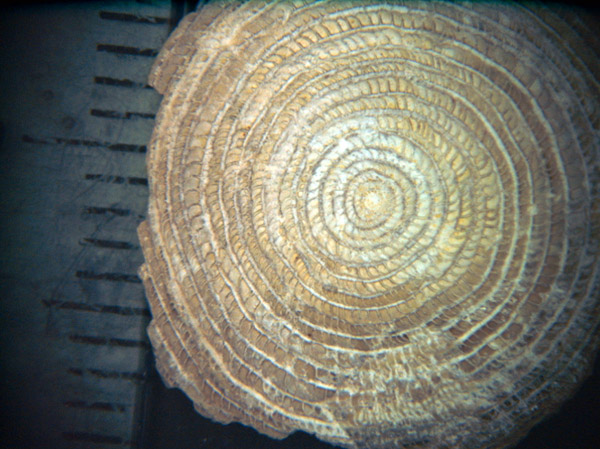
I found a rock it looks like a fossil, could someone tell me if it is a fossil and if yes what is it?
Picture of the rock: http://postimg.org/image/tpcv7wokl/
it is about 3 inch in length
7 Answers
- AndrewLv 57 years agoFavorite Answer
Difficult to tell without actually seeing the piece of rock, but the circular structure is reminiscent of some giant (for single celled things) foraminiferans. Nummulites in particular has a similar concentric structure. Your 'fossil' also looks to have a hint of fine septation (division in to chambers) on the right hand side (the approximately radial structures), again like Nummulites.
The link shows a better preserved example:
Source(s): I'm a geologist - busterwasmycatLv 77 years ago
That is a primary feature in the rock, which appears to be a chert of some sort or other (perhaps a sandstone). What I see is an apparent spiral form, like you might see with a gastropod (snail) or nautiloid (molluscs with spiral shells), but it is a very tight spiral. I will be honest though, I don't know what it is. There is another, smaller one a little to the right and slightly up, too.
It may be that you are looking at a cross-section of something that was longer in the in and out direction. Your fossil has some similarity to a crinoid stem. they wouldn't be spiral though. perhaps I am imagining the spiral and it is instead concentric rings?
- Bad Moon RisingLv 77 years ago
It is tough to see the detail but it looks like Andrew is probably correct. It looks like a Foram encased in a nodular Chert or Flint matrix. The environment of the Foram is consistent with the encasing medium. Nummulites is a very good guess!
- 7 years ago
It is most likely a percussion mark made by a strong flush hammer blow by whomever split the rock. This leaves concentric conchoidal fractures plus some radial ones (think like a chipped windshield).
- How do you think about the answers? You can sign in to vote the answer.
- ?Lv 47 years ago
Well, technically it is possible for it to be a fossil mould. So basically, you had a fossil, which was mineralised so there was a harder shell material which then precipitated during diagenesis and left a mould. This is obviously very objective as I have not seen the rock type and have no idea of its origin etc.
Could be some kind of early Ediacaran fauna...have a search for types of fossil moulds
- ZardozLv 77 years ago
You'll not find fossils that delicate in quartzite. That's diffusion of some mineral or another into the surrounding rock.
Source(s): [n] = 10ⁿ - Anonymous7 years ago
Stop lying you did not take that.